Exercise 4.2 - Travels in Hyperidentity Context: "Titled "Bodies in Space," it will consider how the body is mediated by both virtual and physical space. The first section, "Radical Identification: The Body Online," is guided in part by a reading of Laura Mulvey's "Visual Pleasure and Narrative Cinema" and convenes artists who seek radical sources of personal or sexual identification in the internet age: Bunny Rogers's self-portraits as a mop or cat urn, Ann Hirsch's retelling of her preteen online relationship with an older man, or Laurie Simmons's photographs of the "doller" subculture. The second section, "The Body in Public," focuses on the organization of the body in public space and focuses on Magali Reus's custom-produced stadium seating, Alice Channer's floppy clothing cast in aluminum, and Nicolas Deshayes's slightly skewed public interior architecture. Lastly, the work of AIDS-3D, which ...
Popular posts from this blog
Travels in Hyper Identity
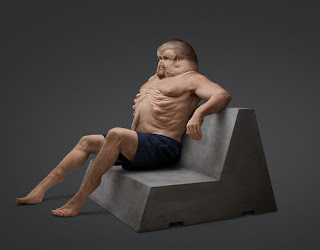
It's not unlikely to imagine an existence in the next sphere of human corporality. Wether influenced by technological factors, evolutionary, or more likely both, I think it's not improbable that our bodies will modify, transgress and break the boundaries of our current human skin. While it's all speculation, a small, ghostly version has already occured-through our digital presence aka trans-bodily internet expressions. Internet clones, 'deepfakes', impersonation, we've already encountered a potent combination of expressing internal consciousness within a different set of parameters. No matter what, I think it we consider ourselves human, we will consider ourselves to have a body. "These artists encourage us to revel in the materiality of our own anatomy, regardless of how far we've traveled from it." From Patricia Piccinini : Graham The comforter The naturalist Wether we interpret this externally or internally is a complex aspe...
Reading Response Compilation
Claire Bishop - Digital Divide While reading this article, I found it very interesting to see Bishop talk about research and curative work. In the past I wouldn’t think of curation or researching art to be an art form. However, after reading the portion about collecting pictures of Niagara Falls, I realize that it can be a form of art within documentation. I often times perceive digital art as lesser than other forms of art because I think we have taught to think that way. When more people have access to creativity, it seems that it has a lesser value. I also think this is due to the fact that there is no limit to the art you can find, however this is different when you go to physically see pieces in a museum for example. The museum has a certain number of exhibits and you regard them as important where as the content online is endless and therefore easier to access and worth less. Mark Fischer - The Slow Cancellation of the Future Although the idea of...


Comments
Post a Comment